
.jpg?height=500&name=robina-weermeijer-3KGF9R_0oHs-unsplash%20(1).jpg)
by Alexa Marks, RDThe journey to recovery after a traumatic brain injury is fueled by more than...
By Alexa Marks, RD, CDN
Have you ever walked the aisles of the grocery store and felt nothing but confusion? You’ve likely seen terms like ‘sell by,’ ‘best if used by,’ ‘low fat,’ ‘fat-free,' ‘zero trans-fat,' ‘good source of,' etc. These terms are intended to make understanding food labels even easier but sometimes, it just becomes more confusing.
I’m here to help!
Nutrition Labels:
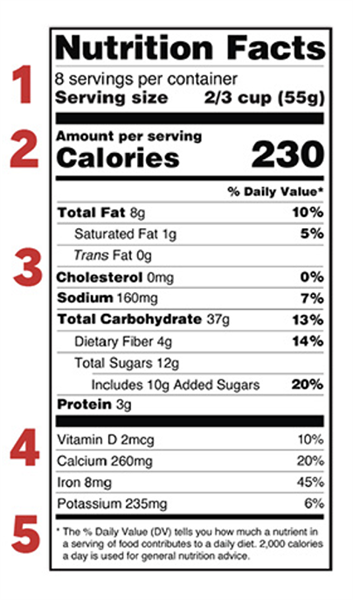
In 2016, the Food and Drug Administration (FDA) mandated all food manufacturers implement important changes to the Nutrition Facts label for all packaged food products. These changes reflect updated scientific information and new nutrition research and are intended to make it easier for consumers to make better-informed food choices. While the requirements for when manufacturers had to implement these changes varied, most food packages in stores now include this updated label.
Nutrition labels are simple to understand if you know what you’re looking for. Check out this helpful guide from the American Heart Association for an in-depth review of each of the five sections of the Nutrition Facts label.
Now that you have a better handle on the label let’s start decoding!
Allergens:
Milk, eggs, fish, Crustacean shellfish, tree nuts, peanuts, wheat, and soybean are the top eight allergens listed on food labels today (2022). It’s important to note that as of January 1, 2023, ‘sesame’ will also be added to this list. If a food product includes one of these eight allergens, the food label must declare it by naming the food source of a major food allergen on the label immediately after or next to the list of ingredients in a ‘contains’ statement.
Packaging Dates:
20% of American food waste is a result of package confusion! It’s important to note that FDA only regulates expiration dates for infant formula. Here’s what you need to know about everything else:
- ‘Sell by’: this is the last date a seller can display the product for sale. This is not a result of food safety but for inventory management.
- ‘Use By’ or ‘Best if used by’: this is the date recommended for the use of the product while at peak quality, flavor and/or freshness. While this is important for highly perishable foods, it doesn’t guarantee the food will spoil by this date (or even before!)
- Any food that smells bad looks odd, or has visible signs of mold should be thrown out immediately.
More Labels:
|
LABEL |
DESCRIPTION |
NOTES |
|
Reduced |
25% less of the specified nutrient or calories than the original product |
The original product may not be low-calorie, so cutting 25% may mean this is still a high-calorie food |
|
Good source of |
10-19% of the Daily Value (DV) of a particular nutrient per serving |
|
|
High In (or excellent source of) |
20% or more of the DV of a specified nutrient per serving |
|
|
Fat-Free/Sugar-Free |
<0.5 gram/serving |
|
|
Low Fat |
<3 gram/serving |
|
|
0 trans-fat |
<0.5-gram fat/serving |
|
|
Light |
The product has 1/3 fewer calories or 50% less fat than the original product. |
|
|
Low Calorie |
< 40 calories per serving |
|
|
Calorie Free |
< 5 calories per serving |
|
|
High Fiber or Excellent Source of Fiber |
Contains at least 20% (5 grams) of your daily fiber requirement |
Fiber benefits: reduces constipation, lowers cholesterol levels, regulates blood sugar levels, aids in healthy weight |
|
Good Source of Fiber |
Contains 10-19% of the daily fiber requirement (2.5-4.9 grams) |
Recommended 14 grams of fiber per 1,000 calories |
|
Sodium Free |
< 5 grams Na per serving |
|
|
Very Low Sodium |
< 35 grams Na per serving |
|
|
Low Sodium |
< 140 grams Na per serving |
|
|
No Salt Added/Light in Sodium |
50% less sodium is added during processing than normally added to the original food item |
Caution: many products with less sodium, less salt, or light on the label may still have too much sodium |
|
100% whole grain or 100% whole wheat |
All grains are whole |
The ONLY label means all the grains are whole. |
|
Whole grain or whole wheat |
At least 50% of the grains are whole. |
|
|
Made with whole grains |
An unspecified amount of whole grains |
The majority of whole grains can be refined |
|
Multigrain |
Made with more than one type of grain |
|
Interested in learning more? Check out some of our recent Blog posts, including Diet for Heart Health and Nutrition for Diabetes Management, for more tricks for staying healthy and eating well!
This content is for educational purposes only and is meant to provide general information. It is not a substitute for professional medical advice, diagnosis, or treatment. Always consult your healthcare provider with any questions or concerns about your health. In case of a medical emergency, contact your doctor or call 911 right away.
.jpg?height=500&name=football%20team%20(002).jpg)